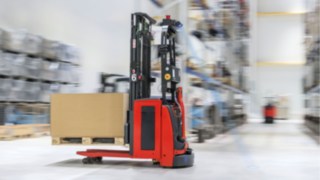
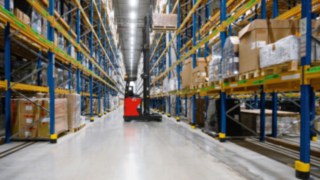
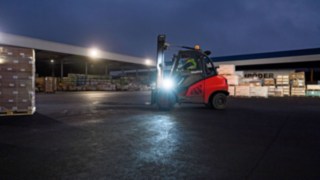
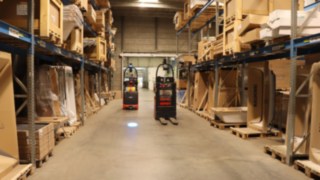
Automated guided vehicles are driverless conveyors which are controlled
automatically and operated without human intervention. They are used to transport
material with the aid of active or passive load-carrying equipment by means of both
pulling and carrying.
Automated guided vehicles (AGV) are playing an increasingly important
role in modern intralogistics. The term stands for an overall system, which
comprises automated guided vehicles (AGVs), a master control, units for data
communication and loading stations. Automated guided vehicles have a wide range of
uses. The focus is on their role of transporting goods from A to B without human
intervention, thus taking over from the non-value-adding transport.
AGVs offer a number of benefits in everyday warehouse operations: They
take over repetitive transport tasks from employees, create optimum process
stability, and thereby reduce error and accident rates in the warehouse. With its
autonomous vehicles from the MATIC series, Linde Material Handling offers AGVs for
virtually any customer requirement. The perfect device is part of this offer.
As part of an automated guided vehicle, driverless trucks need to move quickly and
safely through the warehouse environment. Two types of navigation technology are
available for this.
Track-guided navigation With this option, the AGVs move using visual aids
or magnetic tracks. The sensors of the autonomous logistics vehicles navigate to
the desired destination by means of this track guide. Forward planning is
required for this kind of track guide. Companies need to consider in advance
precisely what their ideal route network should look like. Subsequent changes to
the specified routes are often costly.
Natural Feature Navigation With natural feature navigation, AGVs are
controlled by means of a laser-assisted navigation system. Additional
infrastructure such as guide rails or light reflectors are not necessary. The
AGVs scan their surroundings in all directions with laser sensors. The natural
feature navigation is incredibly flexible and can be adjusted to new routes and
surroundings with little effort. Mapping of the surroundings is performed during
commissioning with the aid of the AGVs. This process enables additional sections
to be added and used with little effort. Intelligent control software
coordinates the routes and speeds of multiple automated vehicles as required.
Linde uses natural feature navigation in its autonomous MATIC trucks too.
Small to large: These trucks are used in AGVs
Virtually any type of industrial truck known in manual operation can be used in an
AGV. This includes autonomous tractors, pallet stackers, counterbalanced forklift
trucks, reach trucks, and very narrow aisle trucks. Automated platform trucks are
also incredibly efficient, especially in very tight spaces. They can lift and set
down load carriers directly from a transfer station or together with trolleys that
can be driven under.
The MATIC series from Linde comprises the following AGVs:
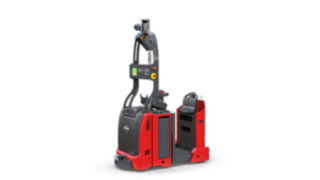
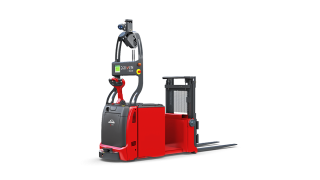
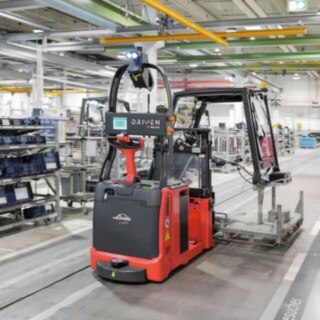
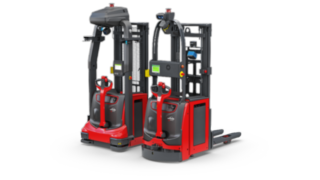
The Linde P-MATIC autonomous electric tow tractor with stand platform moves towing
loads of up to 5000 kilograms and is perfectly suited to use supplying production
halls in industrial companies, for example. It is preferred for production delivery,
removal of waste, and for hauling larger loads.
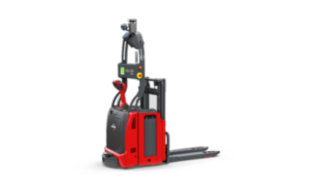
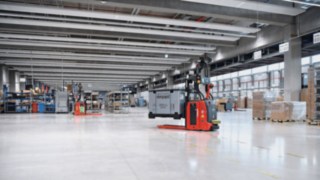
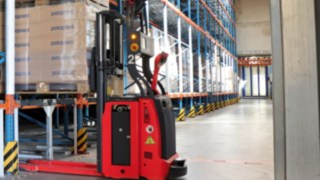
The L-MATIC automated pallet stacker from Linde is perfect for storage and retrieval
at low heights and for transporting loads. It is optimized for handling pallets and
pallet cages. It transports loads of up to 1200 kilograms and can pick up and set
down pallets at heights of up to 1.60 meters.
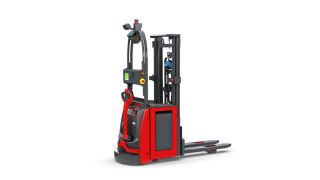
The Linde L-MATIC HD automated pallet stacker is ideal for picking up and setting
down medium-duty loads. Depending on the model, the trucks can transport up to 2
tons of heavy loads. Depending on the weight and load geometry, shelf heights of up
to 3.20 meters can be reached.
The L-MATIC AC autonomous pallet stacker from Linde has a cantilevered fork. It moves
loads of up to 1200 kilograms and reaches shelf heights of 1.60 meters. It
simplifies transport of closed load carriers, for example during transfer of Euro
pallets, and is especially well suited to goods receipt at transfer stations that
cannot be driven under.
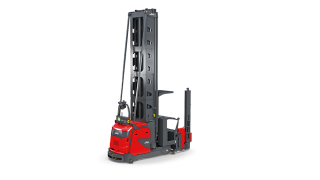
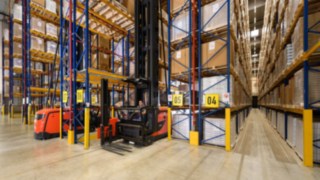
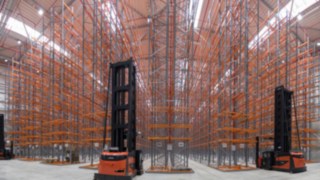
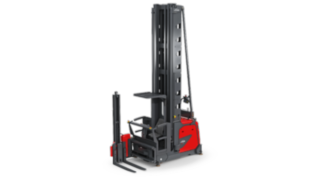
The K-MATIC autonomous very narrow aisle truck from Linde is the perfect choice when
dealing with particularly high heights. It lifts loads of up to 1500 kilograms and
reaches lift heights of 14 meters during storage and retrieval. In the process, the
K-MATIC interacts seamlessly with infrastructure such as belt conveyors or packing
stations.
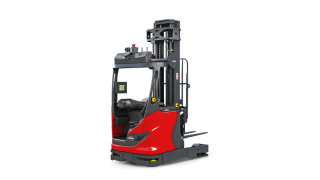
The R-MATIC autonomous reach truck is designed for storage and retrieval of goods at
up to 11 meters in height. It can manage load weights of up to 1600 kilograms.
Thanks to a range of possible masts, it is equally suited to use in warehouses, for
transporting materials, and for supplying workstations. In warehouses, its small
size is particularly useful, as it can access narrow paths and thereby enables
higher storage capacities.
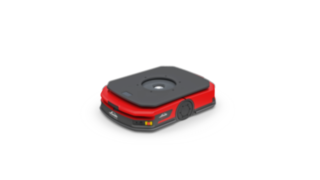
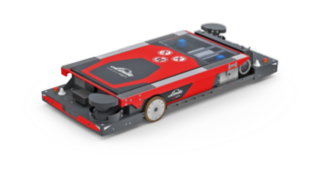
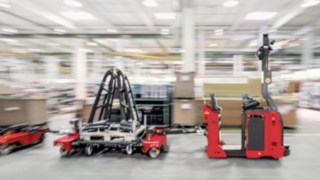
The Linde C-MATIC automated mobile platform demonstrates its strengths in low-level
material transport in tight spaces. Loads are picked up with trolleys that can be
driven under and can be positioned anywhere in the space at the destination.
Transport between static reloading stations or conveyor belts is also possible.
Depending on the model, the C-MATIC moves loads of 600, 1000, or 1500 kilograms.
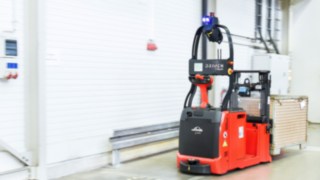
The autonomous Linde C-MATIC HP mobile transport robot autonomously moves loads on
under-ride transport tables weighing up to 1,000 kg over medium and long distances,
without a permanently installed infrastructure. Thanks to laser-based natural
feature navigation, the mobile platform vehicle can also be used very well in mixed
traffic with other trucks.
Efficient and safe: That’s why it’s worth switching to an AGV
For many companies, it makes a lot of sense and is necessary to switch their in-house
intralogistics fully or partially to an AGV. This is for the following reasons:
Fewer staff: The use of AGVs means that non-value-adding transport tasks
can be automated. This combats the lack of skilled workers and also saves costs.
With manually controlled logistics vehicles, the required staff alone accounts
for around 80% of the overall costs.
Continuous operation: What’s more, driverless vehicles can be used 24/7.
To achieve this, material flows are optimized as part of the automation process,
which significantly increases the overall handling capacity.
Lower error rates: AGVs also increase safety in goods handling. The
result is reduced rates of errors and accidents in the warehouse and thereby
lower costs from damage to goods or the building infrastructure.
It’s all in the mix: Use AGVs in mixed operation
Mixed operation of autonomous and manual industrial trucks is possible at any time. The AGVs
from Linde can be controlled manually if required. This works because they are based on
manual devices that have been subsequently automated. Autonomous forklifts, tractors, and
pallet trucks in the MATIC series have intelligent navigation and safety technology for
mixed operation. They can therefore work with people and manual trucks with ease in very
tight spaces. The laser scanners on the AGVs enable safe movement and prevent collisions.
Autonomous mobile robots (AMRs) are becoming increasingly important in modern
intralogistics. The driverless platform trucks are used for automated or partially
automated goods transport and thereby noticeably increase efficiency in warehouses
and logistics hotspots.
Fully networked: AGV interfaces with ERP and WM systems
Networking is essential for smooth processing of automated material flows. Two areas
are particularly important here: ERP (Enterprise Resource Planning) systems
facilitate comprehensive planning and coordination of tasks and resources. Warehouse
Management Systems (WMS) cover all internal goods movements and increase efficiency
in complex environments. The AGVs from Linde can communicate with ERP and WM systems
for optimum automation. The intelligent control functions of AGVs also enable
synchronization of vehicles and automatic hall doors. Connection to traffic light
systems and the fire alarm system is possible too.
Professional implementation: How AGVs are integrated into existing systems
In order to automate individual process sections or entire material flows into
existing warehouses, the support of specialist staff is required. When it comes to
the development and implementation of an automation solution , Linde supports its customers with its
own Implementation Team. Linde specialists help with the selection and design of the
trucks, integration into existing processes, and ultimately operation of the system.
Thanks to the infrastructure-free natural feature navigation, the trucks can be
integrated quickly and easily into the existing process. If conditions change, the
system can be adapted and rescaled without huge effort.
When opting for an AGV, the main costs lie in the procurement of the trucks and
commissioning of the system. The individual costs depend on various factors. First
and foremost, the fleet size and the complexity of the application. Experience shows
that investment in an AGV pays off very quickly. This is not least due to the fact
that processes are optimized through automation and significant staffing costs are
saved.
FAQ – Frequently Asked Questions about AGVs
What is understood by the term automated guided vehicles (AGVs)?
An automated guided vehicle takes over automated transport and warehouse tasks.
The AGVs are usually guided by rails or magnetic strips. The MATIC trucks from
Linde, on the other hand, use significantly more flexible natural feature
navigation, which means that AGVs find their way by means of laser sensors. AGVs
are used in material transport, storage and retrieval in racks, when
transferring material to material handling technology, and when supplying
material to production lines.
Why should I choose an AGV?
AGVs offer a number of benefits. This includes in particular maximizing the
efficiency of internal material flows. This is due to the fact that an AGV
increases the coherence and maneuverability of in-house material flows. In
addition, AGVs lower dependence on staff and reduce the risk of accidents and
damage in transit, while increasing the reliability of transport processes.
Furthermore, AGVs improve the coherence and maneuverability of in-house material
flows.
What is the difference between AGVs and autonomous mobile robots
(AMRs)?
An AGV is an overall system for automating processes in in-house material flows.
It consists of an automated guided vehicle (AGV), master control, units for data
communication, and loading stations. The vehicles used move on defined routes
and use the free natural feature navigation for orientation. Autonomous mobile robots (AMRs) on the other hand, rely
more heavily on flexible navigation, which does not require additional
infrastructure, with QR codes also being used here.
What types of AGV are there?
Different types of vehicle can be used in AGVs, including automated tractors,
pallet stackers, counterbalanced forklift trucks, reach trucks, and very narrow
aisle trucks. For transport by means of short and mid-length routes in tight
spaces, automated mobile platforms are also a good choice. Depending on the
model of vehicle used, AGVs can fulfill various tasks, including transport from
floor to floor, from floor to rack, or from material handling technology to
material handling technology.
What kind of safety systems are used with AGVs?
AGVs are equipped with a number of safety solutions which help to ensure
risk-free material flow. The standard components include laser scanners with
various safety zones and monitoring areas, as well as curtain lasers for
detecting hovering obstacles. The trucks are also fitted with an emergency stop
switch.
Who are AGVs suitable for?
AGVs are perfect for companies which already have a high level of standardization
in their material flow processes. This includes, for example, the
standardization of the load carriers and the regularity with which certain loads
need to be transported from point A to point B. In general, the more
standardization, the more efficient the automation. It is particularly
cost-efficient to use AGVs in multi-shift operation.
Success stories – automated guided vehicles in use
Our dispatch logistics are good, but how can we make them even better? This was
the challenge facing ebm-papst, a leading producer of fan and motor products, at
its site in Mulfingen, Germany. The answer: Fully automate one of its material
flow processes using trusted expertise from Linde. The project has proven a huge
success, so much so that transport volumes have exceeded expectations and
further automation projects are already being planned thanks to this impressive
start.
For FIEGE, one of Europe’s leading contract logistics companies, automation has
been part of working life for years. The company is now partnering with Linde
Material Handling to tackle another innovatory project: automated wide aisle
storage and retrieval by driverless reach trucks. A visit to the site of the
pilot project in Worms, in the German state of Rhineland-Palatinate.
We all know transparency trumps all in contract logistics. Even better if this
can be generated as efficiently as possible: Transport and logistics service
provider Gebrüder Schröder GmbH & Co. KG relies on the Linde Warehouse
Navigator, which not only speeds up and simplifies processes on site, but also
visualizes stock levels in real time for customers too.
If demand, and therefore the production volume, increases, this is actually a
cause for celebration. But how can you manage the increased flow of goods
without burdening employees with more and more repetitive transport assignments?
At the plastics processor Poloplast, the answer is automation, made by Linde.
The LINHARDT Group is a leading specialist in packaging, and at its headquarters
in the German town of Viechtach, it’s all action in the high rack warehouse.
Thanks to Linde technology, efficiency and ergonomics are on the up now too.
Two Linde L-MATIC pallet stackers make their rounds between the warehouse and
dispatch at Austrian sanitary equipment specialist HOLTER. Meanwhile, the human
colleagues get to focus entirely on their actual work: value-adding order
picking.
“Gofar” and “Fargo” are the names for the automated warehouse trucks which
transport packed lights to the finished goods warehouse at Fagerhults Belysning
in Sweden. The investment in Linde L-MATIC devices by the renowned lighting
company was a success and is proof that people and automated trucks can work
together with ease.
Sander Fördertechnik GmbH enabled KOMSA AG to build one of the highest
narrow-aisle warehouses in Saxony and Thuringia. The K-series combination trucks
from Linde, which Sander uses as Komsa, have a navigation system, aisle safety
assistant and Linde System Control (LSC) for regulating the lifting and travel
speeds.
With the help of our dealer Schöler, the L-MATIC AC autonomous pallet stacker is
now in operation at Joma-Polytec GmbH. The automated guided vehicle uses natural
feature navigation to independently navigate around the logistics warehouse. By
taking this step towards automation, Joma-Polytec benefits from streamlines
processes and increased efficiency.
Simple doesn't always mean banal: proof of this is the automation project of
Linde Material Handling for BASF Italia. In order to optimize efficiency and
safety, a flexible, secure and fast-to-implement solution for Logistics 4.0 was
integrated on the basis of an automated guided vehicle (AGV).
In times when customer requests are becoming increasingly individual,
intralogistics also has to adapt to the altered production conditions. The
example of Heidelberger Druckmaschinen AG (Heidelberg) in Wiesloch/Walldorf
shows how this can take place at a globally active industrial company.
The main factory of the French metal packaging manufacturer Massilly in Cluny
relies on extensive automation in the production process. Until recently the
final process step, transporting the pallets to the warehouse, was conducted
manually. This task is now also being performed by automated industrial trucks,
with great success. Representatives of the company are now traveling to Cluny to
see for themselves the benefits of Linde robotics equipment.
Every year, the Marketing Department of Wolf GmbH, a systems supplier for
heating, ventilation, air-conditioning and solar technology based in Mainburg,
Lower Bavaria, develop a motto that aims to give employees orientation and
motivation. The theme for 2016, "Courage to change," could not be more
appropriate for the acquisition of the first automated industrial truck at the
plant.
The Opel plant in Aspern, Austria is the company’s first site to commission fully
automated vehicles for longer distances. In doing so, the carmaker is placing
its full trust in Linde’s expertise. The challenge lay in integrating the
autonomous trucks into the existing systems.
The task: To transform a former production hall into a high-performance logistics
center within just a few months. The solution: A comprehensive approach, close
collaboration—and the right project partner. Model: The new spare parts
logistics solution from construction machinery specialists Yanmar Compact
Equipment Europe at the plant in Rothenburg ob der Tauber, Bavaria.
For FIEGE, one of Europe’s leading contract logistics companies, automation has
been part of working life for years. The company is now partnering with Linde
Material Handling to tackle another innovatory project: automated wide aisle
storage and retrieval by driverless reach trucks. A visit to the site of the
pilot project in Worms, in the German state of Rhineland-Palatinate.
Linde Material Handling supports the automotive industry in the key
challenges of intralogistics: ensuring production flow, saving costs, using
automation, protecting the environment.
The main factory of the French metal packaging manufacturer Massilly in Cluny
relies on extensive automation in the production process. Until recently the
final process step, transporting the pallets to the warehouse, was conducted
manually. This task is now also being performed by automated industrial
trucks, with great success. Representatives of the company are now traveling
to Cluny to see for themselves the benefits of Linde robotics equipment.
Every year, the Marketing Department and Management Board of Wolf GmbH, a
systems supplier for heating, ventilation, air-conditioning and solar
technology based in Mainburg, Lower Bavaria, develop a motto that aims to
give employees orientation and motivation. “Courage to embrace change”, the
message for 2016, could not be more appropriate with regard to the purchase
of the company’s first robot industrial truck.
Automation is one of the trending topics in intralogistics. In this
interview, Tobias Zierhut, Head of Product Management Warehouse Trucks,
explains why data will play a key role in the future of warehouse
technology, and why Linde Material Handling sees itself as the market leader
in robotics.
The Opel plant in Aspern, Austria, is the first Opel location to commission
fully automatic vehicles for longer distances. In doing so, the carmaker
relies entirely on Linde's expertise. The challenge was to integrate
autonomous driving into the existing systems.
Simple does not always mean trivial: proof of this is the automation project
of Linde Material Handling for BASF Italia. In order to optimize efficiency
and safety, a flexible, secure and fast-to-implement solution for Logistics
4.0 was integrated on the basis of an automated guided vehicle (AGV).
With the Robotics4Retail survey, the EHI Retail Institute is investigating
how robotics and automation are revolutionizing intralogistics. Who are the
drivers of automation and what comprehensive solutions and industrial trucks
does Linde offer?
At LogiMAT 2024 in Stuttgart, Linde Material Handling focussed on the topic
of automation. Other topics included energy, safety and warehouse
intelligence.
Automation promises greater efficiency in production logistics. However, in
some cases a manual or partially autonomous scenario can be more
cost-effective than fully autonomous operation. Digitalization expert Frank
Heptner explains what makes the difference.